

Ted Turner, CNN Founder and Captain Planet Co-Creator, Dies at 87
The cable TV pioneer who launched 24-hour news, built networks like CNN, TBS, and Cartoon Network, and co-created an animated eco-superhero to teach kids about pollution, has died.
Ted Turner died on May 6, 2026, at age 87. Turner Enterprises confirmed the news, saying he passed peacefully surrounded by family after years of battling Lewy body dementia.
If you came up watching cable in the 1980s and 1990s, you watched Ted Turner’s networks. CNN. TBS. TNT. Cartoon Network. Turner Classic Movies. The man basically invented the idea that television could run twenty-four hours a day with something other than a test pattern, and the cable industry that exists today is built on the foundation he poured.
He was also a working philanthropist who pledged $1 billion to the United Nations, conserved more than two million acres of land, and helped restore bison herds across the American West. Whatever else can be said about him, the legacy is real.
TL;DR
Ted Turner died May 6, 2026, at 87 after a long battle with Lewy body dementia.
He launched CNN in 1980 from a converted Atlanta motel and pioneered the 24-hour news format every cable network has copied since.
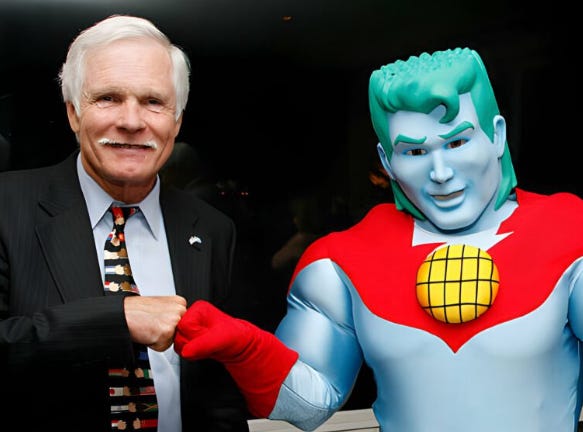
He co-created Captain Planet and the Planeteers with producer Barbara Pyle in 1990 to teach kids about conservation, and founded the Captain Planet Foundation in 1991.
He pledged $1 billion to the United Nations in 1997 and conserved more than two million acres of land through the Turner Foundation and Turner Enterprises.
His controversial 1980s effort to colorize black-and-white classics sparked a fight with Hollywood that previewed today’s AI-alteration debates almost word for word.
The Cable Empire He Built
Born Robert Edward Turner III on November 19, 1938, in Cincinnati, Turner took over his father’s billboard company in the 1960s and pivoted into television. He bought an Atlanta UHF station in 1970 and turned it into WTBS, the first cable superstation beamed nationwide via satellite. That model brought reruns, movies, and Atlanta Braves games to viewers far outside the local broadcast range.
In 1980, he launched CNN from a converted Atlanta motel. Twenty-four-hour global news. The format had never existed before. CNN became the template every cable news network has copied since, and the operation Turner stood up in 1980 is recognizable in every breaking-news desk operating today.
He later added TNT, the Cartoon Network in 1992, and Turner Classic Movies. TCM was cable’s first dedicated classic-film channel, and to this day it’s where serious film fans go to actually watch the old stuff, presented respectfully and in context. The way Turner intended.
Captain Planet and the Environmental Work
In the late 1980s, as he prepared to launch the Cartoon Network, Turner pushed for programming with substance. He co-created Captain Planet and the Planeteers with producer Barbara Pyle, an animated series that ran from 1990 to 1996 about five teenagers from around the world who summoned an eco-superhero to battle pollution.
Turner came up with the character’s name during early development. He told colleagues the show needed “a superhero for the Earth” with “meat on the bones.” The series aired on TBS and in syndication and became a defining piece of 1990s kids’ television. Turner and Pyle established the Captain Planet Foundation in 1991 to support youth-led environmental projects. The foundation is still operating today.
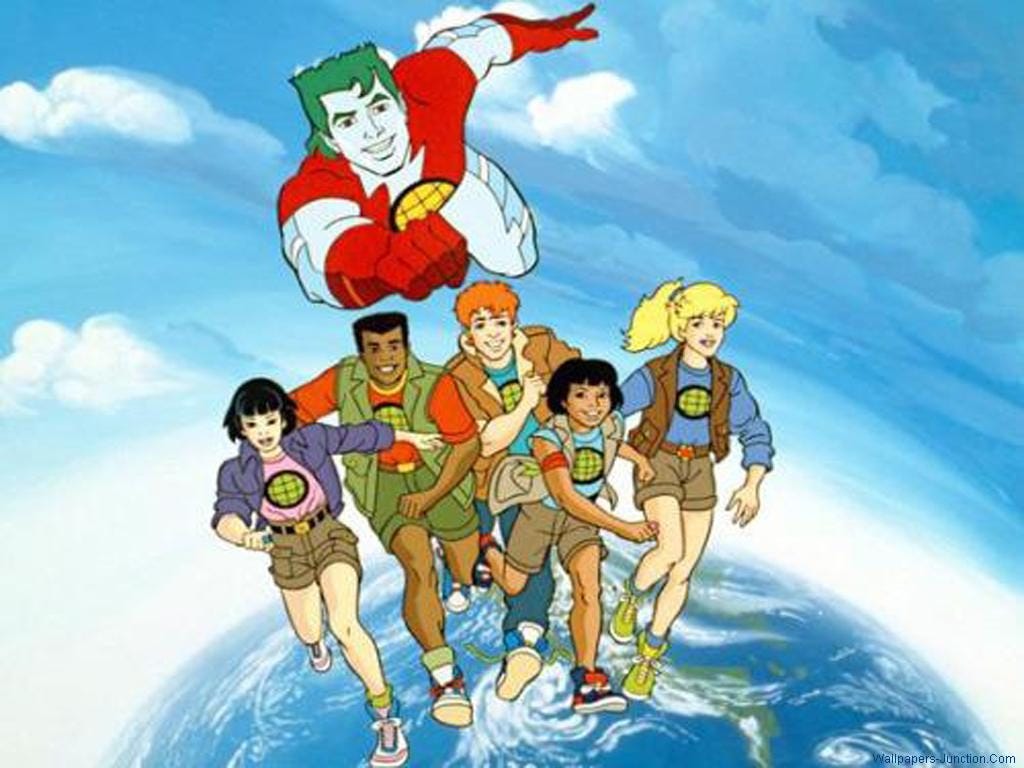
If you grew up in that era, you remember the theme song. Earth! Fire! Wind! Water! Heart! The show’s environmental messaging was earnest in a way that media for kids has largely stopped being, and a lot of millennials trace their environmental awareness back to Saturday mornings with the Planeteers. That counts for something.
The environmental work wasn’t just television. Turner’s $1 billion UN pledge in 1997 was substantial enough at the time to actually move budget conversations at the UN. He conserved more than two million acres of land. He founded Ted’s Montana Grill restaurants partly to promote bison meat as a sustainable protein and to support bison herd restoration on Western lands. The Turner Foundation supported environmental causes for decades.
Sports, Wrestling, and the Atlanta Era
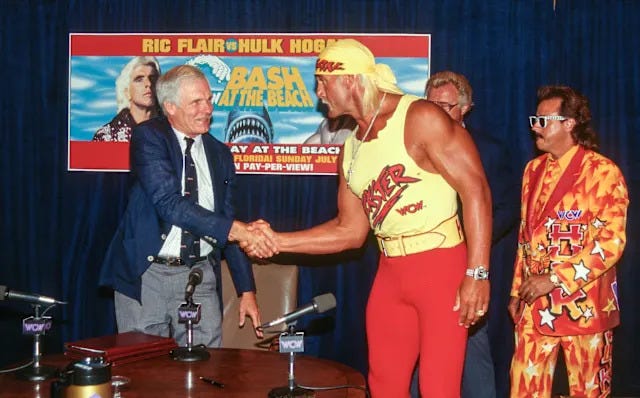
Turner owned the Atlanta Braves and the Atlanta Hawks, and he revitalized World Championship Wrestling during its 1990s peak, when WCW was actually beating WWF in the ratings during the Monday Night Wars era. The Braves dynasty of the 1990s — fourteen straight division titles — happened on Turner’s watch. He was also famously visible in the owner’s box, which made him an unusually personal figure in an era of corporate sports ownership. Owners aren’t supposed to be characters anymore. Turner was a character.
The Colorization Fight, and What It Looks Like Now
Not every part of the Turner legacy was uncontroversial. Turner Entertainment owned the rights to thousands of films from the MGM, RKO, and Warner Bros. libraries. Starting in the mid-1980s, the company used early computer technology to add color to black-and-white classics including Casablanca, The Maltese Falcon, and Yankee Doodle Dandy.
Turner defended the practice in 1986. “The last time I checked, I owned the films that we’re in the process of colorizing,” he told the Los Angeles Times. “I can do whatever I want with them, and if they’re going to be shown on television, they’re going to be in color.” He added: “I like things in color. We see in color.”
Hollywood was not having it. Directors and actors pushed back hard. Orson Welles reportedly asked a friend not to “let Ted Turner deface my movie with his crayons” regarding Citizen Kane. The colorized practice eventually faded as audiences and critics turned against it.
And honestly, the argument Turner made in 1986 is the same argument every AI company makes today.
The colorization debate raised exactly the questions now surfacing with AI tools that generate, enhance, or restyle existing creative works. Critics in 1986 argued the changes distorted history and artistic intent for commercial gain. Supporters, including Turner, claimed the updates made older content accessible to new audiences who would otherwise skip it. The technology owners argued accessibility and modernization. The original creators argued artistic integrity. Forty years later, those positions are showing up almost word for word in the AI debates happening right now.
Turner ran the playbook first. The current arguments aren’t new. They’re a re-run of one Turner started, and the resolution probably won’t look much different than the resolution of the colorization fight, which is to say the technology eventually lost steam when audiences decided they preferred the originals.
What He Leaves Behind
Ted Turner reshaped how Americans watched television, helped spark the environmental awareness of an entire generation through Captain Planet, and gave away enough money to materially affect the United Nations and the American conservation movement. He took risks that didn’t always work, picked fights he didn’t always win, and left behind networks and foundations that continue to operate decades after he stepped back from active leadership.
The cable industry he helped invent now faces new pressure from streaming and AI, on questions that look an awful lot like the ones Turner started raising forty years ago. Whatever you think about colorized Casablanca, the broader Turner legacy is the kind of legacy most people don’t manage in three lifetimes: CNN, TCM, Cartoon Network, Captain Planet, the conservation work.
Want More Clownfish TV?
This article was brought to you in part by The Reefers of more.clownfishtv.com. Subscribers there get the full Clownfish TV podcast feed including livestreams and members-only episodes that don’t make it to the free side, plus articles like this one delivered to their inbox. Free subscribers get the articles. Paid subscribers get everything.
You can also watch the show on YouTube at @ClownfishTV where new episodes drop daily.
And if you’d rather listen on the go, the Clownfish TV podcast is available on Apple Podcasts, Spotify, iHeart, and wherever else you get your podcasts. Hit subscribe, leave a 5-star rating, and write us a review if you’ve got a minute. It actually helps.
About the author:
Thom “Kneon” Pratt is a former newspaper journalist and working comic book creator turned accidental podcaster, accidental YouTuber, and accidental game maker. He co-hosts the Clownfish TV podcast and the Pirates & Princesses podcast, both with Geeky Sparkles, where they cover our weird timeline, geek culture, tech, games, theme parks, and occasionally the paranormal. Gen X, eclectic, based in Pittsburgh. Follow him on X at @kneon.
Hat Tips:
CNN, “CNN founder Ted Turner dead at 87” (May 6, 2026)
Los Angeles Times, “Turner Defends Move to Colorize Films” (Oct. 23, 1986) — original quote source
Mental Floss, “’Colorizers’: When Ted Turner and Hollywood Clashed Over Colorizing Classic Movies” (June 29, 2023)
TedTurner.com, “Ted Turner Legacy” — Captain Planet and philanthropy details
Captain Planet Foundation, “Our Story” — creation history with Barbara Pyle
Wikipedia, “Ted Turner” entry — biography and death details